
Home / Blogs
Solar Panels for a 4-Bedroom House UK — Cost & Output
Proximus Solutions
Free Consultation
We assess your home & energy usage
Proximus Solutions
Tailored Systems
Tailored to your goals and property
Proximus Solutions
Expert Installation
MCS Certified installation by our experts
Proximus Solutions
Start Saving
Lower bills and more energy independence
Proximus Solutions
Ongoing Support
We are here for you, Every steps of the way
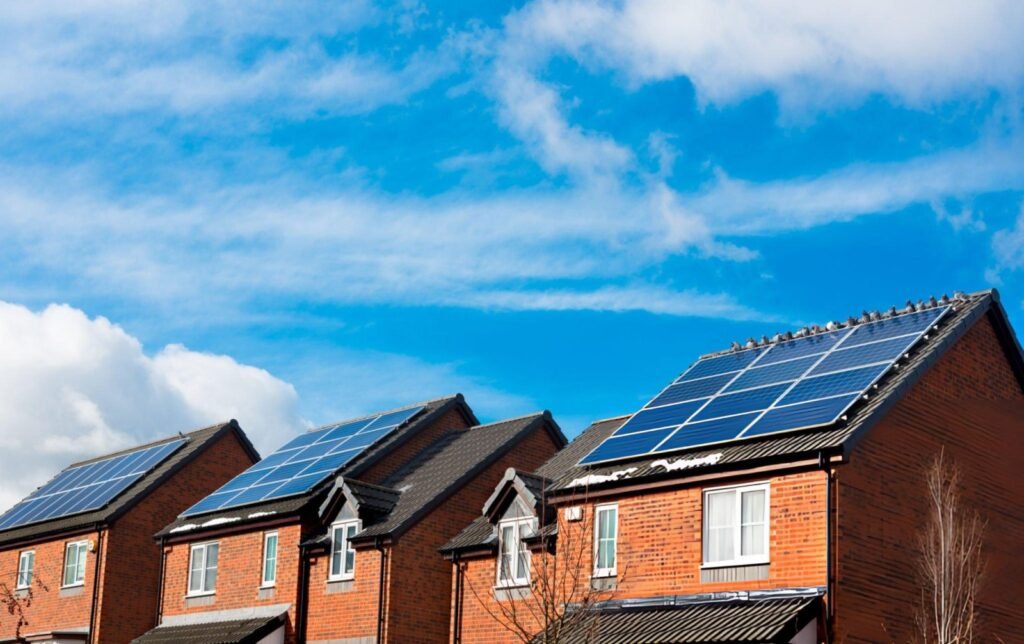
A 4-bedroom home is one of the strongest candidates for housing solar in the UK. Higher electricity consumption means more opportunity to offset bills with your own generation — and more financial return over the system’s lifetime. This guide covers what size system you need, what it costs, how much it generates, and what your savings could realistically look like.
Solar panel cost and output for 4 bedroom house
Recommended system size | 5kW – 6kW |
Number of panels | 11 – 14 |
Typical installed cost | £7,500 – £10,000 |
With battery storage | £10,000 – £15,000+ |
Annual generation | 4,250 – 5,100 kWh |
Annual bill savings | £700 – £1,200 |
Payback period | 9 – 16 years |
VAT rate | 0% until 31 March 2027 |
What Size Solar System Does a 4-Bedroom House Need?
A 4-bedroom household in the UK typically uses between 3,500 and 4,500 kWh of electricity per year. The exact figure depends on how many people live there, whether the home is occupied during the day, and the mix of appliances in regular use.
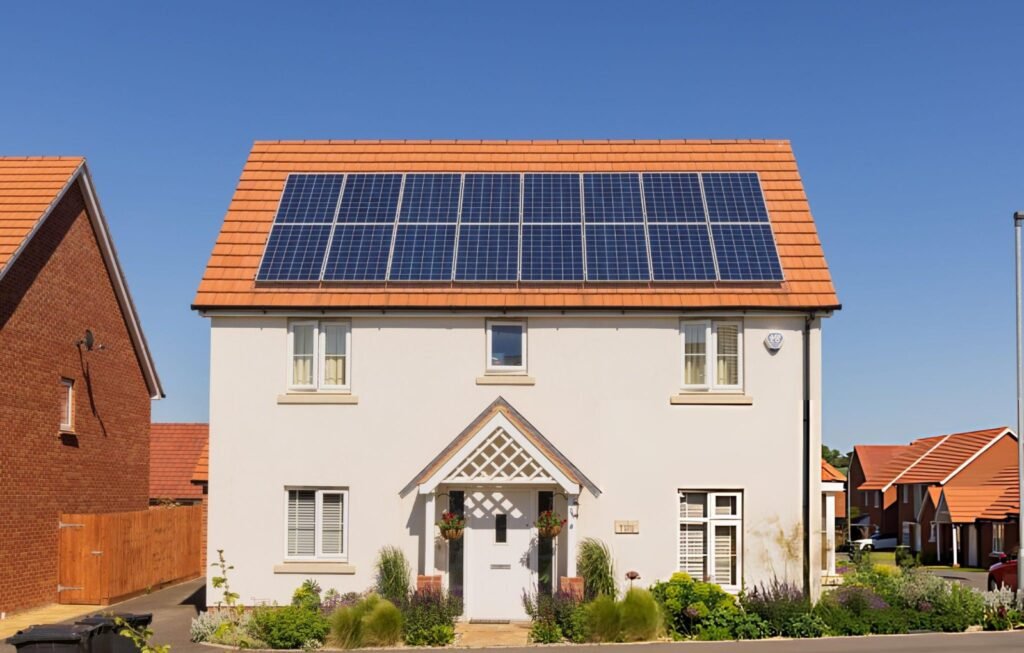
For this level of consumption, a 5kW to 6kW solar system is the right starting point. A 5kW system — typically 11 to 12 panels — covers most households in this range comfortably. A 6kW solar power system adds capacity for higher usage, for homes planning to add an EV charger, or for properties with enough roof space to make the extra panels worthwhile without significantly changing the overall cost.
On a typical UK day, a 5kW system generates around 11.6 kWh of electricity. That’s enough to run a washing machine, tumble dryer, electric shower, oven, and other household appliances — with generation left over to store or export.
How Many solar Panels Do You Need?
The number of panels depends on the wattage of the panel itself. Modern residential panels generally range from 400W to 500W:
Panel Wattage | Panels Needed for 5kW | Panels Needed for 6kW |
400W | 13 panels | 15 panels |
450W | 12 panels | 14 panels |
500W | 10 panels | 12 panels |
Higher-wattage panels reach the same system size with fewer panels, which are useful if your usable roof space is limited.
How Much Roof Space Is Required to install 5kw to 6kw system?
A 5kW system typically requires around 35 to 40 square meters of unshaded roof space, accounting for the panels themselves, inter-panel gaps, and the clearances required from roof edges, chimneys, and other obstacles. A south-facing pitched roof at 30–40° gives the best results, though east and west-facing roofs still perform well.
How Much Does Solar Cost for a 4-Bedroom House?
Installation costs for a 4-bedroom home fall within the following ranges in 2026:
System | Without Battery | With Battery Storage |
5kW | £7,500 – £8,500 | £10,000 – £14,000 |
6kW | £8,500 – £10,000 | £12,000 – £15,000+ |
These figures cover everything included in standard installation: panels, inverter, mounting hardware, cabling, scaffolding, DNO notification, commissioning, and the MCS certificate required for Smart Export Guarantee registration. There are no hidden extras in a properly quoted fixed-price installation.
0% VAT currently applies to all residential solar panel and battery installations and will remain in place until 31 March 2027. From April 2027, VAT is scheduled to increase to 5%.
What's Included in the solar panel Price?
A complete solar installation covers:
- Solar panels from a tier-1 manufacturer
- String or hybrid inverter matched to the system size
- Roof mounting rails, hooks, and fixings appropriate for your tile type
- DC and AC cabling, isolators, and fuse protection
- Scaffolding for safe roof access
- DNO (Distribution Network Operator) notification or application
- MCS-certified commissioning and system sign-off
Battery storage is usually priced separately and added to the system cost. A 5kWh battery — the most common size for a 4-bedroom home — typically adds £3,000 to £4,500 to the overall figure.
How Much Electricity Will Solar Panels Generate?
A 5kW solar system in the UK produces approximately 4,250 kWh per year on average. A 6kW system produces around 5,100 kWh. These figures assume average UK irradiance — actual generation varies meaningfully by location:
Region | Annual Output (5kW System) |
Southern England | 4,500 – 5,000 kWh |
Midlands and Wales | 4,000 – 4,500 kWh |
Northern England | 3,800 – 4,200 kWh |
Scotland | 3,500 – 4,000 kWh |
Around 70% of your annual generation arrives between April and September. Winter months produce meaningfully less, which is why solar panel battery storage and a well-sized system matter — you want your summer surplus to work as hard as possible.
What Are Your Potential Annual Savings with Solar Panels?
The annual savings for a four-bedroom residence with solar panels are typically between £700 and £1‚200 depending on how much of the electricity generated by the solar panel for home and how much is exported․
Without battery storage: Households that are out during the day will export most generation to the grid and be mainly paid the Smart Export Guarantee (4p-20p per kWh depending on your supplier) ․ Direct savings are lower but still good: often £400-£700 annually․
With battery storage: Storing excess generation for evening use can increase self-consumption from 30-40% to 70-80%‚ and make savings of between £700 and £1200 a year in most cases․
Smart Export Guarantee (SEG): Any exported electricity receives a payment via your energy supplier․ The highest SEG tariff rates available to energy consumers in Great Britain sit at around 15-20p per kWh․ Getting registered for SEG requires an MCS-certified installation — your installer handles this as part of commissioning.
How Long Does It Take for Solar Panels to Pay for Themselves?
For a 4-bedroom home with a 5kW system, typical payback periods are:
- Without battery: 9 – 14 years
- With battery storage: 10 – 16 years
After payback, the system continues generating free electricity for the remaining life of the panels — typically 25 years or more from the installation date. That means most homeowners enjoy solar energy for household for 15 or more years of near-zero electricity generation costs after breaking even.
Payback is shorter for households that use more electricity during daylight hours, are on higher tariffs, or pair their system with a time-of-use export tariff that rewards both usage and export behavior.
Is Battery Storage Worth It for a 4-Bedroom House?
For most 4-bedroom homes, yes. The key question is when your household uses electricity. If several people are home during the day running appliances, a solar-only system will already offset a large proportion of your bills. But for a family that leaves the house between 8am and 6pm — the typical working and school day — a solar-only system exports a significant amount of generation at a low rate rather than saving you the full import cost.
A 5kWh battery is the most common choice for a home in this size range. It captures the daytime surplus and makes it available in the evening when demand peaks. For high-usage households or those with an EV charger, a larger 10kWh unit delivers greater flexibility.
Solar panel battery costs have fallen considerably and continue to do so. Popular options from manufacturers like GivEnergy, Pylontech, and Tesla (Powerwall) offer 10-year warranties and strong performance records.
Planning Permission and Grid Connection
Planning permission: The majority of domestic solar installations fall under permitted development rights in England and do not need planning permission. Exceptions apply to listed buildings, properties within conservation areas subject to Article 4 Direction, and most ground-mounted systems. Your installer will confirm the position for your property.
DNO notification: Systems with an inverter rated up to 3.68kW on a single-phase supply fall under G98 notification, which your installer handles after commissioning with no waiting period. Larger inverters — which may apply on a 5kW or 6kW system depending on the specification — require a G99 application submitted before installation. In most cases these are approved without issue; it’s a standard check by your local Distribution Network Operator that the local cables can handle the export.
Will Solar Panels Add Value to My Home?
Yes. Home solar panels consistently improve a property’s Energy Performance Certificate (EPC) rating, in many cases by at least one grade. Research from Rightmove found that improving an EPC from D to C increases a home’s value by around 3% on average. For a 4-bedroom home valued at £350,000, that represents approximately £10,500 in added value — on top of 25 years of reduced electricity bills.
Key Takeaways
- A 4-bedroom house needs a 5kW to 6kW solar system — typically 11 to 14 panels
- Installed costs range from £7,500 to £10,000, or £10,000 to £15,000+ with battery storage
- Annual generation of 4,250 to 5,100 kWh covers most of a typical 4-bed household’s usage
- Annual savings of £700 to £1,200 are realistic with battery storage included
- Payback periods of 9 to 16 years, followed by years of near-free generation
- 0% VAT applies until 31 March 2027
- Most installations do not require planning permission
- MCS certification is required for Smart Export Guarantee registration — always use an MCS-certified installer
Final Thoughts
For a 4-bedroom home, the financial case for solar panels is straightforward. Larger homes use more electricity, which means more of your solar generation goes directly to offsetting bills you’d otherwise pay to your supplier. With electricity prices remaining high and the 0% VAT window still open, now is a favorable time to get the numbers in front of you.
Get a Free Solar Panel Price Quote from Proximus Solutions
Getting the right solar panel system starts with getting the right quote. At Proximus Solutions, every proposal is tailored to your property, your energy usage, and your budget — with a fixed price you can rely on and no hidden costs on installation day.
All installations are carried out by our MCS-certified engineers and include 0% VAT until March 2027.
📞 Call us: 0161 521 0099
✉ Email: info@proximussolutions.co.uk 🌐
Get a free quote: proximussolutions.co.uk/contact-us
Frequently Asked Questions
How many solar panels does a 4-bedroom house need?
Typically, a 4-bed house might require 11-14 panels‚ depending on the power of the panels․ For example‚ a 5kW array with 450W panels would typically require 12 panels‚ and a 6kW array would typically require 14 panels․
How much would it cost to install solar panels on a 4 bedroom house in the UK?
The installation cost of a 5kW peak system in a 4-bedroom house is between £7500 and £8500‚ and with battery energy storage between £10000 and £14000․ A 6kW system is £8500-10000 without battery or energy storage and £12000-15000+ with energy storage․
How much do solar panels save on a 4-bedroom house?
Most 4 bedroom properties will benefit from savings of between £700-£1200 per year if solar with battery storage is added․ Without battery storage‚ savings are between £400-£700‚ as more electricity is exported to the grid and is not used in the home․
How long will it take to pay for solar panels for a 4-bedroom house?
However, the majority of system cost is incurred before the end of the payback period‚ which is estimated at 9 to 14 years without battery storage and 10 to 16 years with battery storage‚ after which power generation is at marginal or zero cost for 25 years․
Do I need planning permission for solar panels on a 4-bedroom house?
In general, permission will not be required for solar panel installations‚ unless there are restrictions․ In most cases no‚ as most domestic solar PV panels in England fall under permitted development rights‚ meaning they do not require planning permission․
Exceptions apply to lissted buildings and properties in conservation areas — your installer will confirm what applies to your specific property.
How Much Do Solar Panels Save on Electricity Bills in the UK?
proximussolutions.uk
July 17, 2026
Read More »
How Much Do 10 Solar Panels Cost in the UK? (2026 Price Guide)
proximussolutions.uk
July 9, 2026
Read More »
Government makes Solar Panels Mandatory on New Homes by 2027
proximussolutions.uk
July 1, 2026
Read More »
Octopus Solar Panels Costs & Tariffs 2026: What UK Homeowners Need to Know
proximussolutions.uk
June 24, 2026
Read More »